
Acetal Pellet Drying: When to Consult the Resin Grade Data Sheet
Sealed acetal usually needs no dryer at all. If a lot does, 80 °C for two to four hours, and the risk afterwards is heat at rest rather than humidity.
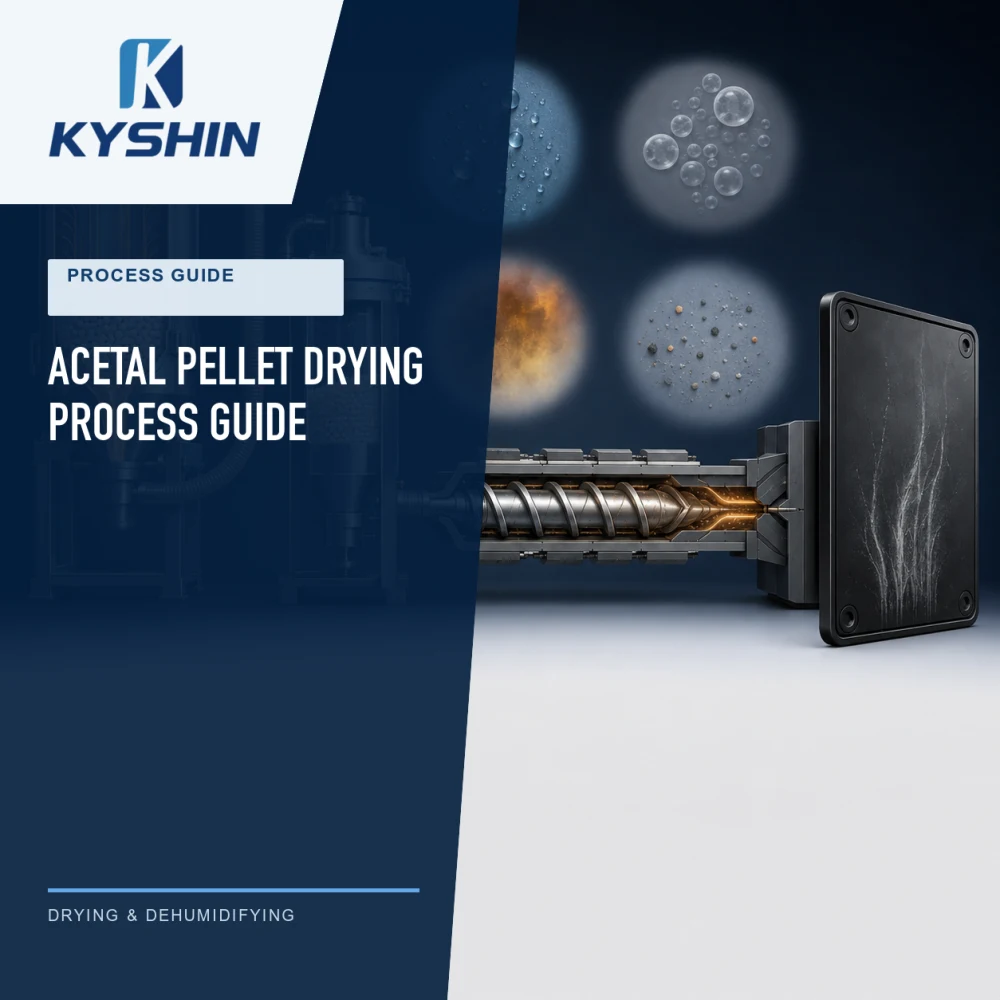
Most acetal (POM) never needs a dryer. Pellets in original sealed packaging are ready to mold, and the producers who publish processing guidance say so directly: BASF's Ultraform documentation treats sealed material as processable without pretreatment. If a lot has been opened, stored warm and humid, or reground, the usual remedy is 80 °C for 2 to 4 hours in ordinary hot air — no desiccant dryer, no −20 °C dew point and no specialty equipment.
That is the whole answer for nine acetal jobs out of ten. The tenth is where money gets spent badly, so the rest of this page is about telling the two apart.
The default holds until packaging does not
Acetal absorbs little water. At 23 °C and 50 % relative humidity the equilibrium sits in the region of 0.2–0.3 %, and most grades tolerate up to about 0.1 % before the melt objects. Compare that with a polyamide reaching 2.5 % and you can see why the polymer is not in the same category as nylon or PET.
Three things move a lot out of the default category.
The first is an opened bag. Once the barrier is gone, the plant climate sets the moisture, and a humid month is enough.
The second is a cold warehouse. Pellets moved from a cool store into a warm, damp production hall are below the dew point of the room air, so water condenses on the pellets and on the inside of the bag. Condensation is fast, it is surface water, and it is the one case where acetal genuinely arrives wet regardless of packaging. Let the bags come up to room temperature before you open them and this mostly stops happening.
The third is regrind. Ground sprues have far more surface area per kilogram than a pellet and they sit in open bins.
If a lot does need drying, 80 °C for 2 to 4 hours is the usual remedy
Hot air is sufficient because the water load is small and, unlike polyester, this polymer is not fighting a deep equilibrium. Producers that publish numbers for exposed material commonly give 80 °C for 2 to 4 hours, and some list hotter, shorter conditions such as 90–100 °C for 1 to 2 hours. The grade data sheet wins wherever it exists.
What matters more than the exact setpoint is that you not treat the number as free. Acetal is thermally nervous: hold it hot for a long time in air and it oxidizes, yellows, and starts giving off formaldehyde, which you will notice as an acrid smell when the hopper is opened. Drying acetal for two hours is a maintenance step. Drying acetal for two days because nobody turned the controller off on Friday is a way to scrap 150 kg of resin.
The hopper that dries it can also cook it
This is the calculation that decides whether the dryer is safe, not just adequate.
A press running a 420 g shot on a 32-second cycle consumes 47 kg/h. Dry for 3 hours and 142 kg of acetal must be at temperature, which at a bulk density near 0.8 kg/L means about 177 L of working volume.
Now run the same hopper at weekend demand. One press idling on a low shot pulls perhaps 6 kg/h, two presses 12 kg/h, and 142 kg of inventory at 12 kg/h is 11.8 hours of residence. The resin that was supposed to spend three hours at 80 °C spends nearly twelve. Nothing in the dryer is broken; the arithmetic changed because the draw did. This is the single most common way a correctly specified acetal dryer still damages material, and the fix is a control decision such as a timer, level control or a smaller hopper for the low-demand period, not a bigger heater.
After drying, the risk is heat, not humidity
Pages about polyamide spend their space on re-moisture. Acetal does not earn that treatment: at 0.2–0.3 % equilibrium it will not climb back to a problematic level across a twenty-minute conveying run, so a standard vacuum loader on ambient air is fine and there is no reason to extend a desiccant header to cover it.
The exposure to manage is time at temperature. A machine hopper holding 40 kg at 80 °C with 47 kg/h going through it is a warm, well-behaved queue. The same hopper over a plant shutdown is 40 kg of resin being slowly oxidized, and it will mold, but the parts will not be the color they were on Friday. Close the lid, drop the setpoint on idle, or empty it. None of that is expensive. All of it gets skipped.
Where a dryer is the wrong purchase
We sell drying equipment. So it is worth saying plainly that for a plant running sealed-bag acetal and nothing else, the honest recommendation is often to buy nothing, and we would rather say that than put a hopper dryer on your floor that gets switched on twice a year and loaded with material nobody measured.
The limitation on our side is real too. We can size a dryer to hold 80 °C and to deliver the residence time your draw requires, and that is verifiable. We cannot tell you whether your specific lot needed drying in the first place, because that depends on storage history and on a moisture measurement you have or do not have. A loss-on-drying check on a sample from the bag takes about twenty minutes and settles the question for less than the cost of a day of dryer electricity.
Where drying is genuinely needed, the equipment is modest and the decisions are few: hot air, 80 °C, a hopper sized to the real draw, and a lid that stays shut afterwards. If the same plant also runs nylon or PET, the picture changes. Those grades want desiccant air and the central drying architecture that comes with it, and acetal can then share the dry-air header at a lower setpoint without complaint. It just should not be the reason the header gets built.
If you are unsure which case you are in, tell us the grade, the packaging state, the storage conditions, and the hourly draw per machine. We will tell you whether a dryer belongs in the project at all, then size it if it does — hopper dryers and dehumidifying dryers in machine-side and central configurations, with the working volume stated at your fill levels rather than at nameplate.