
PMMA Pellet Drying: Preparing Material for Clear Molded Parts
PMMA drying temperature depends on your exact grade and incoming moisture. Learn why you must follow the resin data sheet and how to protect clarity.
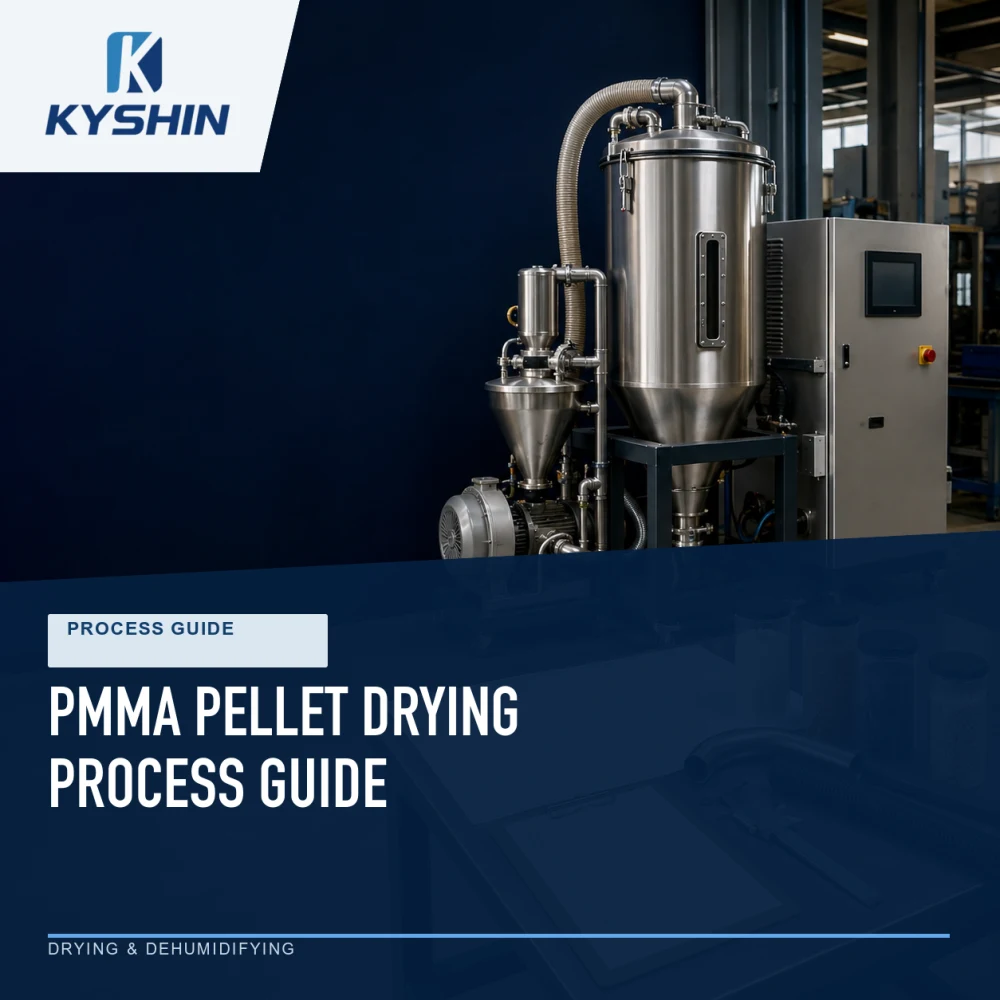
PMMA absorbs far less water than PA or PC, which fools people into skipping drying. Unopened acrylic pellets typically sit around 0.05–0.10 % moisture, and most injection grades want to see no more than about 0.02–0.05 % at the feed throat. That gap is small, but acrylic has no tolerance for the defects moisture leaves behind: a clear part with a bubble or a silver streak is scrap, not a cosmetic second. You cannot dry PMMA by a single published number because the grade sets the window; the data sheet for that exact compound is the only reliable starting point.
The moisture is small, the defect is not
In a clear part, moisture shows up three ways. Bubbles appear when water flashes to steam in the melt. Silver streaking rides the flow front. Haze or a faint yellow tint comes from a longer, slower reaction — hydrolysis and thermal exposure together. None of these are recoverable by re-melting the part.
The reason the numbers are so tight is optical. A 3 mm acrylic lens or light-guide part is inspected against transmitted light, and a single 0.1 mm bubble is visible. So the drying target is not "dry enough to mold" but "dry enough that the melt is optically clean," and that ceiling is usually around 0.02–0.05 % for optical grades and a little looser for general-purpose clear parts.
Grade and data sheet come first
General-purpose PMMA, impact-modified acrylic, and the heat-resistant copolymer grades do not share a drying window. Impact modifiers and the rubber phase in high-impact grades tolerate different temperatures, and pushing a grade past its recommended window risks yellowing before you ever see a moisture problem. Röhm's PLEXIGLAS processing guidance is a good example of the format: it ties drying recommendations to the specific compound and to storage condition, not to "acrylic" as a category.
Settings from polycarbonate or copolyester do not transfer. PC dries hotter and longer; copolyester sits in a different window again. Borrowing either one for PMMA is a routine way to overheat the resin. Get the current processing document for the exact grade and lot, and use its temperature range, time, and maximum residence time as the frame.
What the dryer has to deliver (worked example)
Take a press running a 40 g acrylic lens on a 25-second cycle. That is 40 g × 144 shots/h ≈ 5.8 kg/h. At a 3-hour drying time, the hopper must hold about 17 kg of resin at temperature for the full cycle. PMMA pellets bulk at roughly 0.65–0.70 kg/L, so 17 kg is about 25–26 liters of working inventory.
A 25 L hopper is marginal because nameplate volume includes the cone and the space above the high-level mark. A 50 L machine-side hopper gives you the working band and some buffer. If the press stops for a long lunch, the buffer also matters: PMMA is sensitive to prolonged heat, and resin sitting hot for six hours past its window can yellow.
For a low target like 0.03 %, a hot-air hopper is usually not enough on a humid day. A dehumidifying dryer holding process air at roughly −20 °C dew point is the common working figure, with −30 to −40 °C where the target is tight or the plant swings. A compact machine-side unit such as our compact resin dehumidifier or a three-in-one dehumidifying dryer with hopper covers a single press; the larger hopper dryer series covers bigger shots.
Residence time and regrind are where clarity dies
PMMA does not like being held hot. If the hopper holds dried resin for hours before the press calls for it, and the material exceeds the grade's maximum residence time, yellowing and a loss of clarity follow. Size the hopper to actual hourly consumption, and use a cool-down or shutoff sequence during long stops rather than leaving resin hot overnight. The calculation above is the whole point: a hopper sized for a full shift instead of for the hourly draw is a hopper that over-cooks the material.
Regrind adds variability. Fines dry faster and can over-dry; thick regrind particles dry slower and can arrive wet in the center. Keep regrind clean, free of dust, and confirm the acceptable percentage and any revised drying window with your supplier. For a clear part, the regrind percentage is usually lower than for an opaque one, and a gravimetric blender that holds the ratio tightly is worth more here than on an opaque job.
When the parts come out hazy or streaked
Do not assume the temperature is wrong. Check the dryer first: is it actually delivering conditioned air at the setpoint? Airflow, dew point, and hopper seals all matter. Then measure the moisture of the resin leaving the dryer — a setpoint proves nothing about the pellets. Confirm the dried resin is not re-absorbing moisture on the way to the press; use closed conveying or keep the path short. Then look at the molding process: melt temperature, injection speed, and mold temperature can also create bubbles or surface defects. Contamination from another resin or from regrind is the other common cause.
Change one variable at a time and keep the result. If the problem survives all of that, bring in the resin supplier and the equipment supplier together, because the answer is usually in the grade's own data, not in a new setpoint.
Where a central system fits
For a plant running several clear-part presses, a central drying system can deliver prepared resin to multiple points from one conditioned-air source. We build and supply these as project-configured systems: the central dehumidifying dryer system is sized from the resin types, per-line demand, number of use points, and plant layout, and it does not replace the grade-specific drying parameters — it delivers conditioned air and distributes dried material. Our factory in Zhongshan builds the drying and conveying hardware, and we work with manufacturing partners on some items.
One honest limitation: no dryer fixes a grade run outside its window. If the data sheet says 80 °C for two hours and the hopper is set to 100 °C for six, a better machine will simply over-dry the resin more evenly. The equipment's job is to hold the window you were given, not to widen it.
If you are sizing for a specific acrylic part, send us the shot weight, cycle time, grade, and target moisture, and we will work the hopper volume and dryer type from those numbers.