
Conveying Fragile Pellets Without Excessive Breakage
Cut pellet breakage by sampling along the conveying route, then tuning air velocity to 18-24 m/s, bend radius, and air-to-material ratio to limit impact energy.
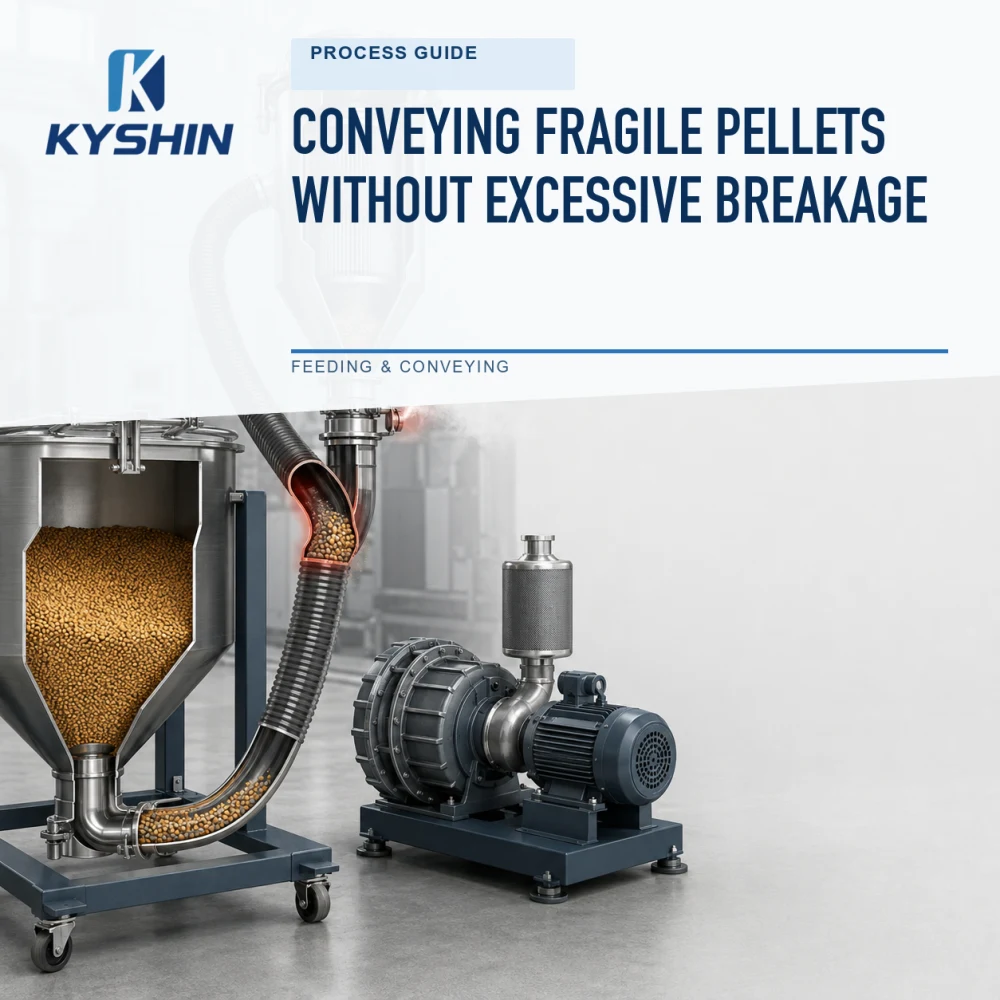
Kinetic energy in a vacuum conveying line rises with the square of pellet velocity, so raising air speed from 20 m/s to 32 m/s does not increase impact damage by 60 % — it multiplies impact energy by roughly 2.56 times. When brittle pellets (high-filler compounds, PMMA, GPPS, glass-filled nylon, or dried PET) shatter into fines and streamers inside a loader line, the usual culprit is excessive conveying velocity hitting short-radius elbows or misaligned pipe couplings. Fixing breakage starts with sampling along the route to pinpoint where pellets crack, then bringing air velocity, bend radius, and air-to-material ratio back inside a controlled range.
Sampling the route before touching blower speed
Changing blower frequency before you know where pellets break usually trades breakage for plugged lines.
Take three 200–500 g samples on the same shift: one directly from the gaylord or drying hopper outlet, one after the first vertical lift and elbow, and one inside the machine-side receiver. Sieve or visually count broken halves and dust at each point.
If fines jump sharply between the pickup wand and the first receiver, the problem sits at the pickup air-bleed adjustment or the first tight bend. If pellets survive the main run intact and only powder inside the receiver, look at tangential entry velocity or a hard deflector plate inside the receiver lid. Zero fines at the pickup followed by heavy breakage at the far press tells you the last 20 m of pipe has a restriction or too many sharp elbows.
Velocity, air-to-material ratio, and why half-empty lines break pellets
Dilute-phase vacuum conveying needs enough air speed to keep pellets suspended — typically around 18–24 m/s for standard 3–4 mm plastic pellets — without turning the pipeline into a sandblaster.
Two things drive velocity past 28–32 m/s in real plants:
- Starved pickup. When a suction probe is buried poorly or the ambient air-bleed valve is wide open on a short 10 m run, the blower pulls mostly air and very little resin. With a low solids-to-air ratio, pellets accelerate close to the free air stream speed and slam into the first bend at full velocity.
- Oversized blower on a short branch. A 4.0 kW central blower sized for a 60 m run will over-accelerate pellets on a 12 m branch unless a vacuum relief valve or variable-frequency drive (VFD) trims the airflow for that station.
Here is the math in plain terms. Impact energy scales with $v^2$: a pellet hitting an elbow at 32 m/s carries $(32 / 20)^2 = 2.56$ times the kinetic energy of the same pellet at 20 m/s. Dropping conveying air speed by just 20–25 % via proper air-bleed tuning at the pickup lance or VFD speed trimming cuts impact energy by roughly 36–44 %, often eliminating visible cracking without plugging the line.
Elbows, couplings, and internal steps in the pipe
Every change in direction or bore diameter is a hammer. Sharp turns cost pellets.
Standard plumbing elbows have a tight centerline radius of 1.5D (about 75 mm on a DN50 / 50 mm pipe), forcing pellets to slam almost head-on into the outer wall and then slide-bounce down the straight run. For fragile resins, replacing 1.5D elbows with sweep bends having a radius of 6D to 10D (300–500 mm radius on a DN50 line) spreads the turn over a longer arc and reduces both shatter and "angel hair" streamers caused by friction melting on hot pipe walls.
Walk the line and check three mechanical details that create hidden impact points:
- Misaligned compression couplings. A 2 mm internal lip where two tubes meet acts like a chisel edge at 22 m/s.
- Crushed or kinked flex hose. A flattened flexible drop near a press accelerates local air speed through the pinch point and strips pellet corners.
- Unlined aluminum bends on glass-filled grades. Glass-reinforced pellets gouge soft aluminum elbows into rough grooves within weeks, turning a smooth sweep into an abrasive file. Stainless steel or borosilicate glass bends hold a smooth bore far longer.
Material form, fines, and when vacuum conveying hits its limit
Virgin cylindrical pellets handle dilute-phase conveying far better than irregular regrind, brittle high-mineral compounds, or long-glass-fiber pellets. Hot pellets fresh out of a 160 °C PET dryer also bruise and smear more easily than cool pellets at 25 °C.
Where fines or streamers are already present in regrind or brittle virgin resin, adding a central material filter with a cyclone stage ahead of the vacuum pump keeps dust out of the blower and prevents fines from blinding cartridge elements and causing erratic line vacuum. For single presses running ultra-fragile compounds over short distances, a separate-blower hopper loader mounted close to the material bin avoids long multi-bend central headers altogether.
We should be honest about the boundary of dilute-phase vacuum systems: any high-speed air-conveying line will still create trace surface scuffing on very soft elastomers or friable long-fiber pellets. If zero breakage is non-negotiable over a 50 m run, gravity feeding from a mezzanine or dense-phase conveying is the better architecture, even though it carries higher structural or capital cost.
How we configure low-breakage conveying at KYSHIN
When we engineer a central material conveying system at KYSHIN, our team at our Zhongshan factory (working with manufacturing partners where specialized bends or valves are specified) sizes the blower, pipe bore, and sweep-bend radius around the weakest resin on your floor, not just the heaviest throughput line.
Send us your resin grades (noting glass-filled, brittle, or regrind streams), pipe run lengths and vertical lifts, number of bends, and hourly kg/h per press. We will review whether pickup air-bleed tuning and long-radius bends on your existing line will stop the breakage, or where a dedicated low-velocity branch makes sense.