
Retrofit Planning When a Plastics Workshop Adds More Machines
Adding 6 presses to a 12-press bay can cut far-receiver throughput 20-35%; recalculate airflow, drying, cooling, and electrical load before retrofitting.
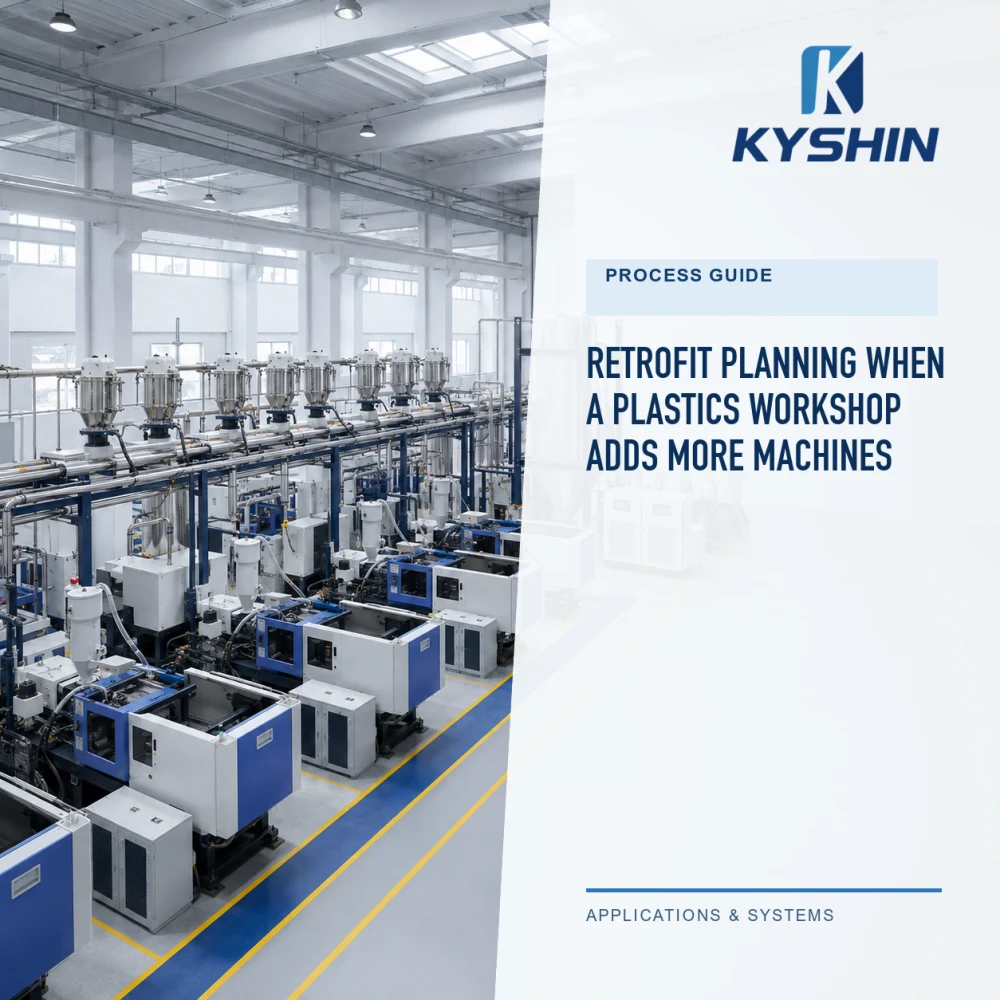
Adding four or six injection molding presses to an existing bay almost never breaks the presses first; it breaks the central conveying, drying, or cooling loops feeding them. On paper, a central vacuum blower or chilled-water header with "30 % spare capacity" looks ready for extra machines, yet adding 25 m of pipe and two more bends can push pressure drop past the point where existing presses start starving for pellets. Planning an auxiliary retrofit means recalculating the shared utilities — conveying airflow, drying residence time, chilled-water flow, and electrical load — before you order a single new loader or pipe tee.
Why "spare capacity" on paper disappears in the pipe
Most central conveying lines fail during an expansion because plants count machine tonnage instead of equivalent conveying distance and simultaneous demand.
Suppose an existing bay runs 12 injection presses consuming an average of 40 kg/h each (480 kg/h total) through a DN38 (38 mm) vacuum line with a 4.0 kW blower. You add six more presses at 45 kg/h each, bringing total demand to 750 kg/h and extending the farthest material run from 35 m to 65 m. Even if the blower's nameplate capacity looks close, two things happen at once:
- Line velocity and pressure drop shift. Pushing 750 kg/h through a single DN38 line with extra elbows increases friction loss and forces longer loading cycles per receiver. At roughly 18–25 m/s conveying air velocity, extending a run by 30 m and adding four 90-degree bends can cut effective throughput at the far receiver by 20–35 %.
- Queue contention starves the farthest press. If one vacuum pump sequences 18 receivers instead of 12, each receiver waits longer between refills. A 15 L machine-side receiver feeding a press running 55 kg/h empties in about 16 minutes; if one stuck valve or a long 65 m refill cycle delays the queue, the press runs dry.
In that scenario, upgrading the blower alone on a DN38 header rarely fixes the problem — it just raises velocity, increases pellet impact breakage, and drives up filter pressure drop. Stepping up the main branch to DN50 (50 mm) or splitting the new six-press bay onto a second dedicated blower loop is usually the cleaner engineering fix.
Checking drying and cooling before touching the layout
Conveying is only one of three shared utilities that hit a wall during a workshop expansion.
Central drying. A central dehumidifying dryer system sized for 480 kg/h of ABS or PC cannot absorb another 270 kg/h of demand without cutting residence time in the drying hoppers. If a 1,000 L hopper holds roughly 650 kg of pellets, at 480 kg/h you have 1.35 hours of buffer; at 750 kg/h you have 52 minutes, which is far short of the 2–4 hours most hygroscopic engineering resins require. Adding new presses on hygroscopic resin almost always means adding dedicated drying hoppers or machine-side dehumidifiers, not just tapping a manifold.
Chilled water. A water-cooled central chiller or cooling tower loop behaves the same way. Adding six presses without checking main header velocity and pump head drops differential pressure at the end of the line, raising mold temperatures on the new machines even when total chiller tonnage looks adequate.
We should state an honest limit here: if your plant lacks the original as-built P&ID, pipe diameters, and blower curve from the first installation, no supplier can verify spare capacity from a floor plan alone. Someone has to measure actual line vacuum (in mbar or kPa), static pressure drop across the central dust filter, and chilled-water supply/return delta-T under peak summer load before quoting an extension.
Defining the mechanical and control interfaces
Retrofits stall during installation when nobody assigns who owns the boundary between old and new hardware. Every connection between the existing system and the added machines needs clear ownership in the purchase order:
- Pipeline and couplings. Confirm outer diameter, wall thickness, and material (stainless steel vs. galvanized or glass bends for abrasive glass-filled resins) so compression couplings seal without an internal step that traps pellets.
- Control interlocks and PLC addressing. Verify whether the existing central controller has spare I/O points for six new vacuum receivers and proportional valves, or whether a sub-panel with Modbus/dry-contact handshakes is required.
- Utilities at the drop. Check 3-phase breaker headroom, compressed-air pressure (typically 0.5–0.7 MPa for pulse-jet filter cleaning and discharge flapper valves), and floor load for any new storage bins or drying stands.
Staged commissioning beats a full-plant switchover
Never connect six new machines, flip one breaker, and call the retrofit done. That shortcut almost always backfires.
Commission one new branch or two machines at a time while the existing bay runs normal production. Measure vacuum pressure at the central dust collector and at the farthest receiver, time a full refill cycle in seconds, and verify that existing presses do not log low-level alarms while the new receivers are calling for material. If an existing press starves when a new machine calls, stop and isolate whether the cause is blower sizing, a blinded filter cartridge, or a control priority setting that favors closer stations.
Document the final pipe routing, valve tags, PLC station numbers, and baseline vacuum/amp readings before signing off. Keep that sheet accessible. Six months later, that single page saves hours of guesswork when a filter clogs or a press changes resin.
How we scope a retrofit at KYSHIN
When customers ask us at KYSHIN to expand a central material conveying system or add auxiliary stations to an existing workshop, we do not start from a catalog price list. Our engineering team in Zhongshan — working alongside our manufacturing partners where specialized components are needed — checks the existing blower kW, pipe diameter, central filter area, resin types, and new machine throughput first.
If the old loop can safely take two or three extra receivers, we will tell you. If the math shows you are better off isolating the new bay on its own blower and drying skid instead of overloading the original main, we will give you both options side by side so you can compare the retrofit risk before committing budget.