
Planning PET Sheet Extrusion Material Preparation
Plan PET sheet extrusion material preparation by defining drying and conveying interfaces, responsibilities, and acceptance checks for a smoother handover.
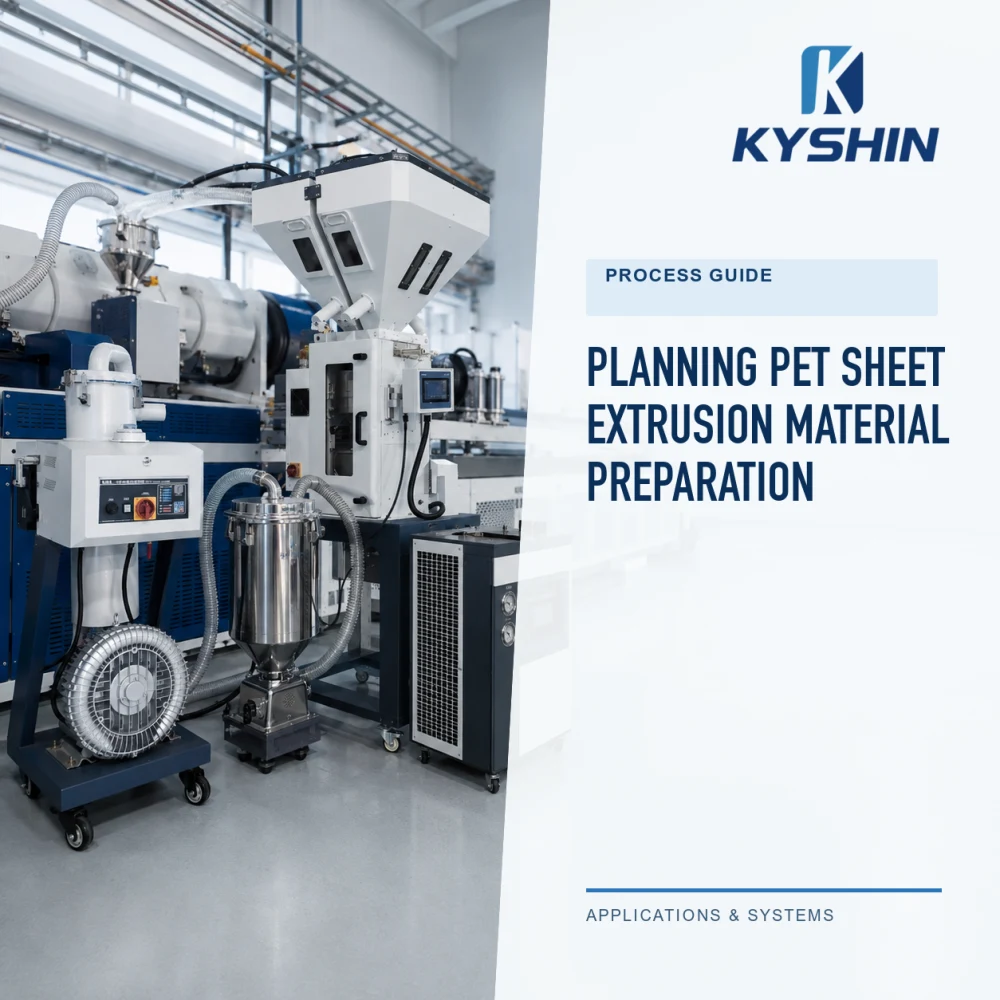
A PET sheet line lives or dies on one number at the extruder throat: the residual moisture in the pellet. Single-screw PET sheet lines running without melt-phase vacuum venting need the feed dried below 0.005 % (50 ppm) moisture to prevent intrinsic viscosity (IV) drop, while twin-screw vented extruders can accept higher moisture or undried flake depending on the vacuum system; crystallizer-and-dryer setups for standard sheet lines commonly run 150–170 °C process air at a −40 °C dew point for four to six hours. Get the drying and conveying interfaces wrong and the moisture climbs back before the melt sees the die.
This page is about the preparation side of a sheet project: where drying ends, where conveying begins, and who owns each step. That boundary, more than any single machine choice, decides whether the line runs to spec.
The drying boundary is a decision, not a default
PET arrives from the resin supplier at whatever moisture the bag or silo left it with, often 0.2–0.5 % for unopened material and higher once it has seen humid plant air. Sheet extrusion needs it orders of magnitude lower. Someone has to own that gap.
In practice the drying step belongs to whoever has the hopper and the dew-point control. On a small line that is the extruder throat, and a machine-side unit does the job. On a line running several hundred kilograms an hour from a silo, drying moves upstream into a central system that feeds the extruder through a closed conveying path. Decide which model you are building before you buy anything, because the two do not mix cleanly.
The resin supplier's data sheet gives you the drying temperature, the dew point, and the residence time for the grade. Take all three. A number without a dew point is half a specification, and a residence time without a bed depth tells you nothing about whether your hopper is deep enough to use it.
What the sheet takes out of the equation
Sheet thickness sets the throughput, and throughput sets the dryer size. A line running 1,200 mm wide PET sheet at 0.6 mm, at a line speed of 30 m/min, is producing 36 m² per minute. At a PET density of 1.33 g/cm³ and a 0.6 mm gauge, that is 28.7 kg/min, or about 1,724 kg/h of melt (or at 18 m/min line speed, 21.6 m²/min and roughly 1,034 kg/h of melt).
Now the drying side. Take a 1,000 kg/h line where the grade wants four hours of residence: the hopper has to hold four hours of consumption, or about 4,000 kg of working inventory. PET pellets bulk around 0.8 kg/L, so that is roughly 5,000 liters of resin sitting at temperature. A 500 L throat hopper cannot do it. Even twin 3,000 L central hoppers only work if the usable fill band, not the nameplate volume, covers the 5,000 L requirement.
That single calculation usually decides the project. Below a few hundred kilograms an hour, a machine-side dryer and a short conveying run are enough. Above it, the math pushes you toward a central drying and conveying system, because no throat hopper is going to hold four hours of PET at a thousand kilos an hour.
Conveying is where dried PET picks moisture back up
Dried PET is thirsty. Move it through open air, a shared line, or a receiver that has been sitting full overnight, and it reabsorbs moisture before it reaches the feed throat. On a sheet line the exposure is short but the target is tight, so the conveying path has to be closed and, ideally, purged with dried air.
The route matters as much as the seal. Every bend, valve, and receiver is a place where pellets can sit and where ambient air can enter. Walk the proposed path and count the direction changes. Measure the longest horizontal run and the vertical lift, because both drive blower or vacuum sizing. A route that looks short on a drawing can be 40 meters of pipe once it climbs to a mezzanine silo and drops back to the extruder.
PET is denser than the polyolefins most conveying systems are first sized against, so a line that moves 800 kg/h of PE may not move 800 kg/h of PET at the same air setting. Give the supplier the resin bulk density and the maximum demand per use point, not a round number that sounds impressive.
Regrind and changeover change the plan
Sheet lines trim edge scrap and reject sheet, and most of it comes back as regrind or skeletal flake. Amorphous PET sheet regrind will soften and agglomerate in a 160 °C dryer unless it is crystallized first or fed through an agitated crystallizer stage, and flake conveys differently from virgin pellets: irregular particle shape, more fines, and a much lower bulk density (often 0.35–0.50 kg/L). If the line runs a virgin-and-regrind blend, the crystallization step, conveying parameters, and hopper volume all shift, and the system has to handle the blend without bridging the hopper or letting the flake under-dry.
Changeover is the other place projects go wrong. A line running several PET grades or colors needs a defined cleaning routine for the hopper cone, the filters, the receivers, and the flexible hoses, plus a decision on how much transition material is acceptable before the sheet is back on spec. Dedicated lines for critical colors are expensive; a documented purge with a measured transition quantity is cheaper and usually enough.
Across our factory in Zhongshan and our manufacturing partners, we supply the drying and conveying hardware for these lines, and we will size a hopper and a route from your throughput and your resin data. What we cannot do is decide for you who owns the drying step. That is a project decision, and it has to be made before the equipment list is written.
Controls and the acceptance trial
The dryer and the conveying system should talk to the extruder controls. At minimum, the extruder needs to see dryer temperature, dew point, receiver status, and alarms. A dew-point deviation on a PET line is not a warning to note in a log; it is a reason to divert material or stop feeding, because out-of-spec sheet is scrap the moment it is wound.
For food-contact and medical sheet, the drying records matter. Time and temperature per batch, retained for whatever period the application requires, reviewed by a named person. Decide that before the trial, not after.
The acceptance trial should run the actual grade at the actual rate. Measure moisture at the extruder inlet against the supplier's limit, check the conveying system for fines and consistent delivery to each use point, and time a changeover so you know what it costs in scrap. Simulate a dew-point fault and a blocked line and confirm the system does what the control philosophy says it will.
One honest limit: we can specify and supply the drying and conveying equipment, and we can run the trial with you, but the moisture target and the drying window come from your resin supplier for your grade. If that data is vague, the trial will be vague too, and no amount of equipment will settle a number the resin data sheet never gave you.
For a project-configured system that routes material from storage and preparation equipment to multiple extruders, see the Central Material Conveying System. For the drying side, the central dehumidifying dryer system and the machine-side three-in-one dehumidifying dryer cover the two ends of the range this page describes.