
Gravimetric Blender Refill Cycles: Avoiding Starvation at the Machine
Learn how refill cycles affect gravimetric blender performance and practical checks to avoid material starvation at the processing machine.
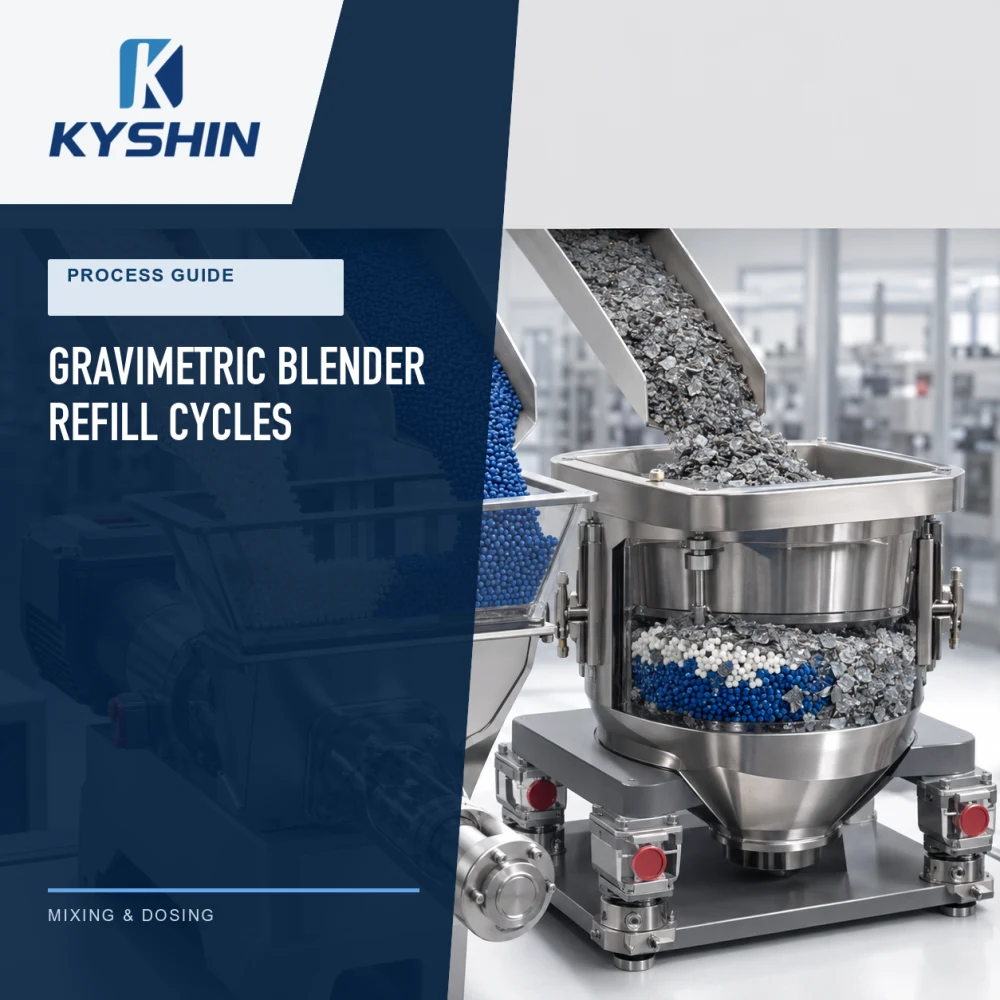
A gravimetric blender starves a machine for one of two reasons, and they look identical from the floor: either the refill arrives too slowly, or it arrives while the blender is weighing and corrupts the batch that was supposed to feed the next shot. The first is a conveying problem. The second is a timing problem, and no amount of extra material fixes it.
The distinction matters because the two failures need opposite corrections. If you speed up a loader that was already disturbing the weigh cycle, you make the weight error bigger and more frequent. The useful question is not "is the hopper empty" but "was the blender batching when the refill hit."
Refill during a weigh cycle reads as a phantom batch
A gravimetric blender works by loss-in-weight or gain-in-weight, depending on the design. Either way the controller is watching a load cell, and a load cell cannot tell added material from material that was supposed to be there. When a vacuum loader dumps 2 kg into an ingredient hopper mid-weigh, the controller sees a step change it did not command.
Some controllers pause batching during refill; others schedule refill between cycles. The behavior is a function of the specific model and how it was configured at commissioning, not a universal rule. A blender that runs clean at 40 kg/h and drifts at 90 kg/h is often not inaccurate — it is refilling more often, and a larger share of those refills are landing inside a weigh window.
The symptom is a batch weight that wanders by a fraction of a percent while the individual ingredient doses look correct. Color streaks in the part, or a part weight that drifts over a shift, get blamed on the blender's calibration. The calibration is usually fine. The refill is landing at the wrong moment.
Size the refill against consumption, not against the hopper
This is the calculation that settles most starvation arguments, and it takes two minutes.
Take a press running a 300 g shot on a 25-second cycle. That is 43.2 kg/h of total throughput. Say the recipe is 97 % resin, 2 % masterbatch, 1 % additive. Resin consumption is about 41.9 kg/h, masterbatch about 0.86 kg/h, additive about 0.43 kg/h.
Now look at hopper capacity. A gravimetric blender's ingredient hoppers are small by design — often 2 to 6 liters for the minor components. At a bulk density around 0.6 kg/L, a 4 L masterbatch hopper holds roughly 2.4 kg. At 0.86 kg/h that is a refill every 2.8 hours, which is comfortable. But the additive at 0.43 kg/h in a 2 L hopper holds about 1.2 kg, so it needs refilling every 2.8 hours as well — and if the loader serving it is shared with three other machines, the actual delivery window is whatever the central system's sequence allows, not what the hopper math says.
That gap is where starvation starts. The hopper capacity looks adequate on paper. The shared conveying sequence, running on a round-robin that gives each of four machines a turn, may only reach that additive receiver every 15 minutes. It works until one machine runs a faster cycle and the sequence falls behind. The minor component is the one that stops the recipe, and it is the one nobody watches, because the resin hopper is still full.
The two failures have different signatures
Slow refill and disturbing refill leave different traces, and telling them apart is most of the diagnosis.
A refill that is too slow shows up as a falling hopper level across a run, a low-level alarm, or a refill timeout. The batch weights stay accurate right up until the hopper empties, then the dose goes short because the weigh chamber could not fill. The controller may log a short batch or simply take longer to complete the cycle.
A refill that disturbs the weigh shows up as weight fluctuation during the refill event, with the hopper level staying healthy. Batch weights drift, but the level never alarms. If you log hopper level at the start and end of a shift and it stays in band while batch weights wander, the refill is not starving the machine — it is interrupting the measurement.
Correlation is a start, not a diagnosis. If unstable batch weights line up with refill events, that is worth taking to the equipment supplier with the batch records in hand. It does not prove the refill is the cause; a load cell mounting that has loosened, or a hopper that is bridging, produces a similar pattern. The refill log is what lets someone else rule those out.
A bigger hopper is not automatically the fix
The instinct when a machine starves is to fit a larger hopper, and sometimes that is right. But a larger ingredient hopper means longer residence time, and for regrind, masterbatch, or a hygroscopic additive, residence time is where segregation and moisture pickup begin. A masterbatch that sits for six hours in a warm hopper can plate out or absorb moisture and dose unevenly — a problem the small hopper never had.
There is also a geometry issue. A taller hopper changes the head pressure on the discharge and the way material flows into the weigh chamber. A hopper that is oversized relative to consumption may sit at a low, stable level where flow is consistent, which is better than a full one that empties in steps.
The honest limitation: we cannot tell you from a product page which hopper size is right for your recipe. It depends on the bulk density of each component, how the conveying sequence is shared, and how the machine's cycle time varies across a shift. What we can do is size the blender and the loader together against your actual peak demand rather than the nameplate throughput, and that is a conversation worth having before the machine is installed, not after it starts starving.
What to record before calling anyone
Four things turn a vague "the blender is starving" into a diagnosis.
Log the refill events: time, ingredient, hopper level before and after, and — this is the one that matters — whether the blender was batching when the refill landed. Next, compare actual batch weight against target for the batches immediately before and after each refill, and note the peak demand rather than the average, because starvation usually happens in the fastest hour of the shift, not the typical one. Do not bypass interlocks, alter sensor settings, or change refill delay and pause parameters to mask repeated starvation without following the equipment manual.
Then check the conveying path against that peak. A loader sized for average demand will fall behind at peak, and the fix may be a dedicated receiver rather than a bigger hopper. Our gravimetric blender series and the central material conveying system are usually specified as a pair for exactly this reason, and the production cell gravimetric blender is the configuration where refill timing and batching logic are designed together rather than bolted on.
We supply mixing, dosing, and conveying equipment built across our factory in Zhongshan and manufacturing partners for part of the range, so we can quote a matched set — but the numbers that decide the sizing come from your recipe and your cycle, not from our catalog. Send us the component list, the peak throughput, and the refill log, and we can tell you whether the problem is the loader, the hopper, or the timing.