
Recovering Extrusion Startup Scrap Without Mixing Resin Grades
Plan extrusion startup scrap recycling so purge blocks and off-spec sheet stay segregated by grade, with controlled size reduction and documented acceptance.
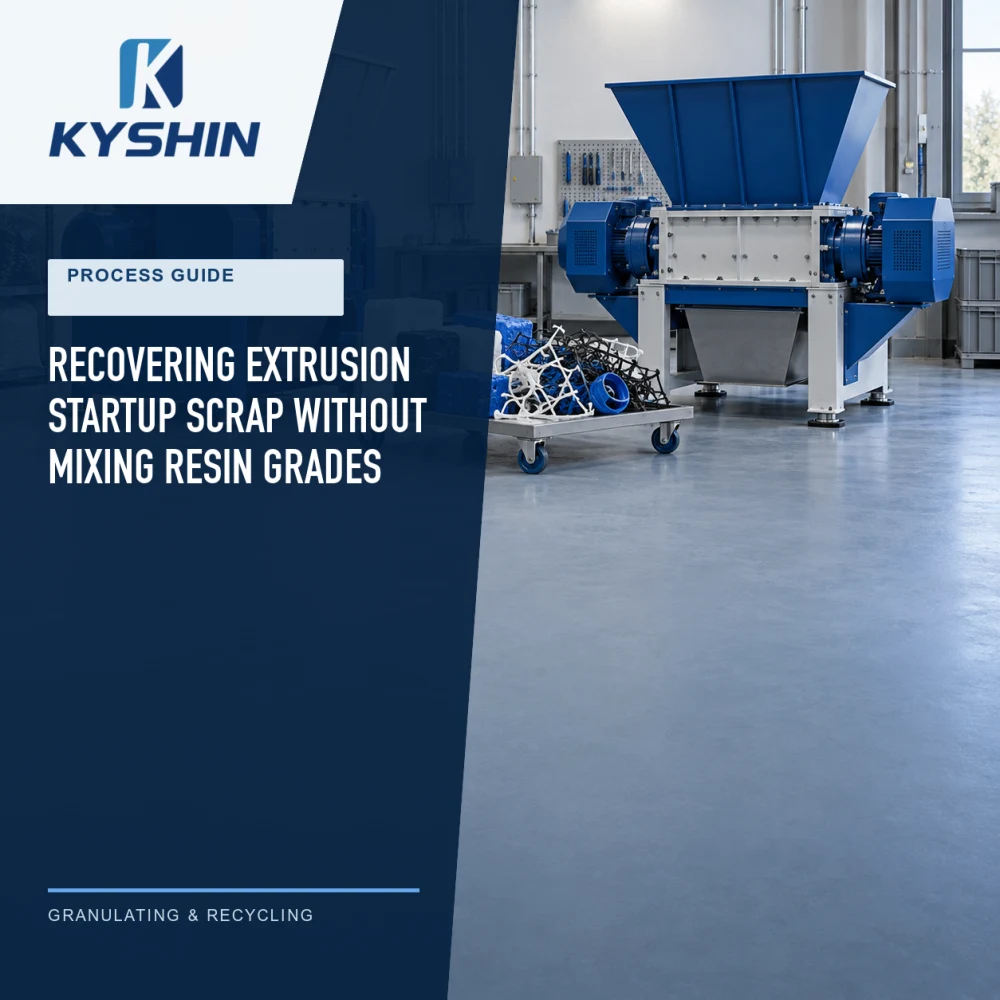
A sheet line that starts up twice a shift throws away a surprising amount of good polymer, and the reason most of it never comes back is not the granulator. It is that the first thirty meters of a run contain four different things — degraded melt, a grade transition, purge compound, and a color change — and they all look like scrap. Put them in one bin and you have made a blend that no recipe can claim, so it sits on a pallet until someone writes it off.
Segregation is the whole job. The size reduction is the easy part.
The startup sequence is four streams, not one
Walk the line with a marker and a stopwatch and find where each stream actually ends. On a typical sheet or profile line the sequence runs: initial purge and degraded melt out of the die; the grade-to-grade transition if you are changing resin; the color transition; and then the clean, single-grade off-spec run while the operator dials in gauge, gloss, and dimensions before good product starts. Each of those has a different value and a different downstream home.
The degraded purge at the front is the one people get wrong. It has been sitting hot in the barrel and adapters, so its molecular weight is already down before it reaches the die. Granulating it and blending it back at 20% will drag the whole batch's properties with it, and you will not see that on a gauge reading. Most plants are better off selling that fraction or running it at a low let-down in a non-critical product, and that is a quality decision, not something the machine decides for you.
The grade transition is different from the gauge-in run that follows it. A 40-second grade transition on a 600 kg/h line is about 6.7 kg of mixed material (and about 0.55 kg on a 50 kg/h line), and mixed means the interface layer is genuinely two incompatible resins. That transition slice is small enough to scrap outright. The real recovery prize is the five to ten minutes of clean, single-grade sheet produced after the old resin is gone while the take-off rolls and die bolts are being adjusted — on a 600 kg/h line, ten minutes is 100 kg of clean, single-grade polymer that only failed thickness tolerance. Keeping the 6.7 kg of mixed transition out of that 100 kg of clean off-spec sheet is what makes the recovery pay.
Thick purge blocks decide the machine before anything else
Startup scrap arrives in forms that behave nothing alike in a cutting chamber: solid purge blocks from the die and adapters, edge trim, sheet sections, and strand. A purge block 300 mm × 200 mm × 80 mm of filled PP weighs around 4.5 kg at 0.9–0.95 g/cm³ and will not enter a standard granulator feed opening without being cut down first.
That single dimension settles more of the layout than motor power does. If the largest block needs pre-cutting, you have added a saw and a person to the process, and that cost lands every startup, not once. A two-stage route — shredder then granulator — handles blocks directly but adds a machine, floor space, and a second cleanout point between grades. Neither is wrong. The mistake is choosing on nameplate kW and finding out about the feed opening after installation.
Feed form, handling temperature, and tramp metal also set the cutting arrangement. Sheet and trim cut cleanly against a screen; thick blocks want a heavier rotor and lower speed, and blocks fed while still hot inside will smear on the knives and blind the screen; hollow sections and nested pieces want a feed arrangement that stops them riding on top of the rotor. Any purge stream that can carry brass tool fragments, die-bolt shavings, or broken thermocouple tips needs metal detection or magnetic protection before the chamber. The plastic granulator range covers the middle of that spread, and where blocks are genuinely large the plastic shredder does the first reduction. We supply both through our factory in Zhongshan and our manufacturing partners, and we will tell you when a single machine will not do the job rather than size one that jams on your first purge.
Contamination happens in six places, and only one is the rotor
The cutting chamber gets all the attention. In practice, material crosses between grades in the feed bin, the discharge chute, the collection container, the conveying line, and the storage silo as well, and any one of those can put a gram of black into a natural batch.
Dedicated containers per grade and labeled feed and discharge points do most of the work. The number that matters is changeover time, measured rather than estimated: how long from last piece of grade A to first acceptable piece of grade B, including the cleanout and the first-off check. A granulator that cuts beautifully but takes 90 minutes to clear is the wrong machine for a plant running four colors a shift, however good its output looks on a trial.
If regrind moves pneumatically, the conveying line is a real mixing point — a few hundred grams of pellets sit in every horizontal run and bend. Short, dedicated runs per grade, or a line that can be purged with a handful of virgin, close that gap. A central system with a filter at the receiver helps here; the central material filter is the part that keeps dust and fines out of the next grade's hopper.
What the next process will actually accept
The receiving process sets the target, and it is rarely a single screen number. Regrind going back into the same extrusion line has to match the virgin particle size closely enough to feed and melt at the same rate; regrind going to an injection machine tolerates a wider distribution but punishes fines, which bridge in hoppers and burn in the barrel.
State the requirement as a distribution with a fines limit, not as "4 mm screen." A granulator set up for 8 mm output on sheet trim typically produces a spread from about 2 mm to 10 mm with a fines fraction under 10%; drop to a 5 mm screen and throughput falls while fines climb. Whether 10% fines is acceptable is your quality team's call. We can describe how a given screen and rotor speed shift the distribution; we should not be setting your product-quality criteria.
Heat history is the quiet one. Regrind from a purge block has already seen one full thermal cycle, and blending it back at a high let-down stacks a second on top. Most plants keep extrusion regrind below 20–30% in the same product and lower for anything with a tight color or impact spec.
Records that let the next trial mean something
A startup scrap record with grade, source segment, quantity, feed form, handling temperature, machine configuration, screen, observed output, and any abnormal event is what turns a trial into data. Without the segment, a throughput figure is just a number — you cannot tell whether it came from clean trim or from a block that stalled the rotor twice.
Keep retained samples labeled separately from accepted regrind. Unknown or transition material should not go back to production unless your quality procedure says so, and that procedure is the plant's to write.
Safety follows the machine manual and your own isolation procedure, not this page. Interlocks stay in service, and nobody reaches into a hopper, cutting chamber, or discharge while the rotor can turn; any access to a hazard area requires full energy isolation under the plant's lockout procedure by qualified personnel.
Where we fit
We supply granulating and recycling equipment across our factory in Zhongshan and our manufacturing partners. When a project requires a trial on your actual startup scrap, the material description, largest piece dimensions and weight, handling temperature, photographs, and intended downstream use let us define the sample and test configuration before anything ships. What we cannot do is decide for you which fractions are worth recovering; that answer depends on your grades, your product specs, and what your quality team will sign off, and it is usually clearer after the first month of segregated records than it is on the day the line is installed.