
Auxiliary Equipment for Automotive Nylon Parts: Material and Process Inputs
Plan automotive nylon molding auxiliary equipment by documenting grade-specific material, process, and interface data before selecting dryers, conveyors, or dosers.
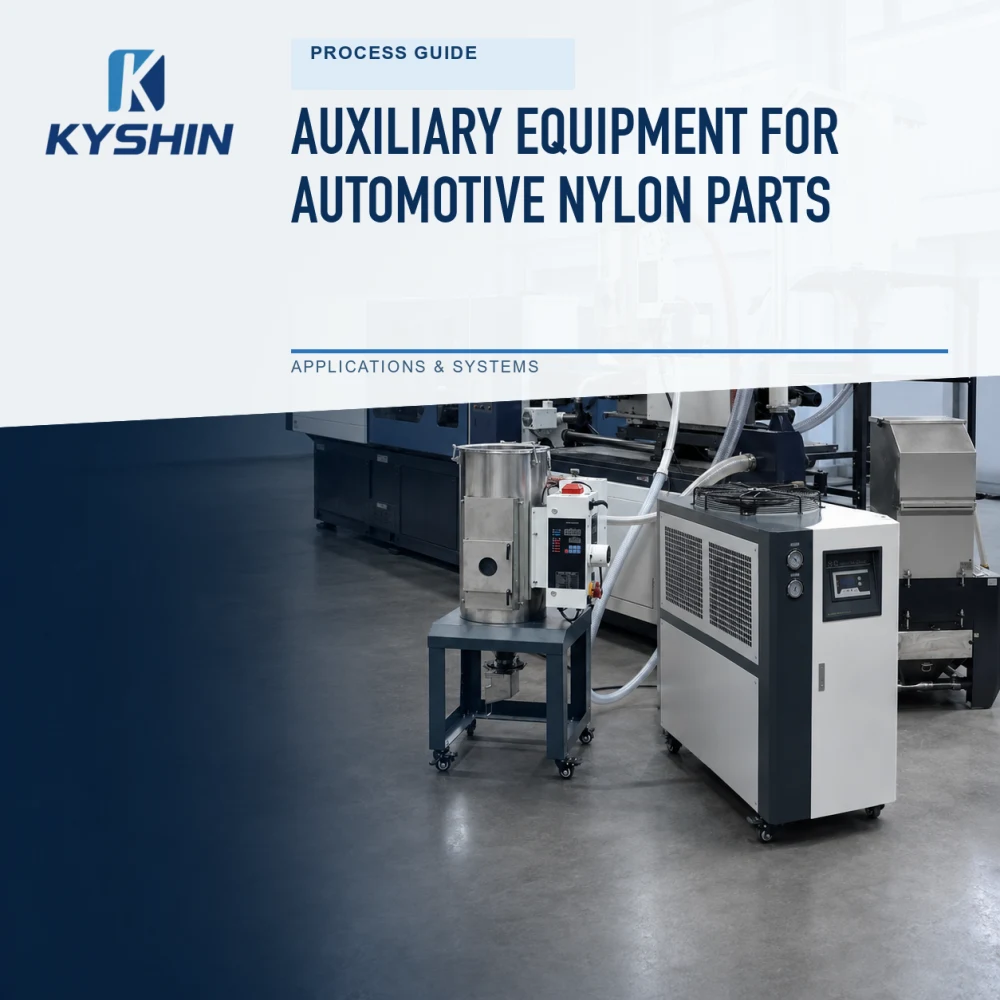
A glass-filled PA66 bracket and an unfilled PA6 clip can run on the same press, in the same week, and need different dryers. That single fact drives most of the equipment decisions on an automotive nylon job. The polymer name on the box tells you almost nothing; the grade, the part, and the plant layout decide the dryer size, the conveying route, and whether the regrind goes back in at all.
What follows is how we scope auxiliary equipment for these parts — what we need from you, what we calculate, and where the numbers usually come from.
The grade decides the dryer, not the word "nylon"
Automotive nylon is a family, not a material. Unfilled PA6 and PA66, glass-filled versions at 15 to 50 percent, impact-modified and heat-stabilized compounds, and PA66/6 copolymers all dry differently.
The drying window moves with the grade. Unfilled PA6 commonly dries around 80 °C; many glass-filled and heat-stabilized PA66 compounds run hotter, often 80–110 °C depending on the additive system, while still respecting compounder limits to prevent thermal oxidation. Flame-retardant grades are the exception in the other direction — push them near their thermal limit and the additive package degrades. The compounder's data sheet for that exact grade is the only safe source, and it should state drying temperature, drying time, target residual moisture, and the test method behind that moisture number.
That last item matters more than it looks. A supplier limit quoted by Karl Fischer titration and an incoming check done on a loss-on-drying analyzer are two different measurements on the same pellets, and a molder chasing a gap between them will spend a week on a problem that does not exist.
For a new program, we ask for the grade sheet before we quote a dryer. A hopper sized for 80 °C and four hours is not the same machine as one sized for 100 °C and two, and guessing costs more to fix later than to get right at the start.
Follow the pellets from the bag to the screw
Draw the route. From the day bin or gaylord, along the header, up to each machine, into the receiver, down into the dryer hopper, out to the feed throat. Every segment has a length, a lift, a bend count, and a receiver volume, and those are the numbers a central material conveying system is actually built from.
Two things about nylon make this route harder than it is for polyolefins. First, dried nylon reabsorbs moisture fast — a dried hopper open to plant air in a humid summer climbs back toward equilibrium within an hour or so, so the path between dryer and press needs to be short and sealed, not a long run across the ceiling. Second, glass-filled grades are abrasive. A shared line that carries 30 percent glass-filled PA66 will wear at the bends, and the wear shows up as fines and dust in the receiver rather than as an obvious failure.
Dedicated lines per material are the clean answer and the expensive one. Where lines are shared, the system has to be able to purge and clear between grades, and someone has to own the changeover procedure.
Regrind is where automotive nylon programs get caught
Runners and sprues come back. The question is at what rate, and the honest answer is that it depends on the part and the customer's approval, not on a rule we can give you.
Glass-filled nylon regrind is the difficult case. Granulating shortens the glass fibers, and a part molded with a high regrind fraction has shorter fibers than the drawing assumed. Impact strength and dimensional stability both move. Many automotive programs cap regrind at 10–20 percent for structural glass-filled parts, some allow none, and the number is set by the OEM or Tier 1, not by the molder.
So we separate regrind streams by resin, color, and contamination history, and we ask what the approved percentage range is before sizing a doser from our mixing and dosing range. Particle form and bulk density matter too: regrind bulk density commonly runs 10–20 percent below virgin pellet, and a volumetric doser set for virgin will under-feed regrind by mass by roughly that margin unless it is recalibrated or replaced with a gravimetric blender.
Sizing the drying hopper: a worked example
This is the calculation that turns a grade sheet into a machine.
Take a press running a 400 g shot on a 35-second cycle in glass-filled PA66. That is 400 g ÷ 35 s × 3600 s = about 41 kg/h of resin. If the grade sheet calls for four hours of drying at temperature, the hopper has to hold 41 × 4 = 164 kg of resin sitting at temperature for the full residence time.
PA66 pellets bulk at roughly 0.65–0.75 kg/L, so 164 kg is about 220–250 liters of working inventory. A 200 L hopper does not do it — not because it is "too small" in the abstract, but because resin passing through in under four hours never reaches the target moisture. A 300 L hopper works only if the usable fill band, between the low-level and high-level controls, actually covers 250 L. Nameplate volume includes the cone and the space above the high-level mark; ask for the working volume.
Now add the second press on the same cell and the arithmetic doubles. This is where a central drying system with a large floor-standing hopper and dedicated conveying lines usually beats two machine-side units, especially when the grade needs −30 °C dew point air that a simple hot-air dryer cannot reach.
Temperature control and the cooling loop
Nylon runs hot molds — surface temperatures commonly in the 80–120 °C range depending on grade and wall thickness — so most circuits need a mold temperature controller running oil or pressurized water, not straight chilled water. List each circuit, its medium, its required temperature, connection size, and distance from the controller.
For the chiller side, size from heat load, not from motor power. A rough check: the heat the mold has to remove is close to the shot weight times the enthalpy drop of the melt times shots per hour. A 400 g shot of PA66 at 41 kg/h, with roughly 300 kJ/kg coming out of the melt between barrel and ejection, is about 3.4 kW per mold, before the hydraulic oil cooler is counted. The oil cooler on the same machine can carry a much larger load, so a chiller sized on the mold alone runs short.
Our heating and cooling range covers mold temperature controllers and chillers; the sizing still depends on your heat-load figures. During installation and service, electrical and refrigerant connections must be handled by qualified personnel following the equipment's isolation procedures.
What we need, and what we do not claim
We supply drying and dehumidifying, feeding and conveying, granulating and recycling, heating and cooling, and mixing and dosing equipment across our factory in Zhongshan and our manufacturing partners for part of the range. What we do not do is verify your grade's drying specification or approve your regrind rate — those belong to your resin supplier and your customer.
Where we can help is the configuration and handover plan. A typical package for an automotive nylon cell is a dehumidifying dryer sized to the residence-time calculation above, a sealed conveying route from a central system or a machine-side loader, a gravimetric blender for the masterbatch and regrind fractions, and a granulator on the runner. Before handover, set observable acceptance checks for each unit: target residual moisture at the dryer discharge, receiver fill rate without cross-contamination on the conveying lines, recipe tolerance at the blender, and particle size at the granulator. Send the grade sheets, a layout sketch with distances, the utility data, the acceptance checks, and the approved regrind range, and we will come back with a scope that names the interfaces and the responsibilities on each side.